
Overview ➣ This article, “Journey of WordPress,” explores the evolution from its 2003 inception to its dominance as a CMS. It highlights key version releases, such as the addition of plugins, themes, and automatic updates, the introduction of the Gutenberg editor, and the shift to full-site editing. This article also illustrates how WordPress has consistently evolved to meet user demands while maintaining its open-source model.
Journey of WordPress – If you want to learn about the journey of WordPress from a blogging tool to becoming the world’s most famous content management system, then in this article, we will tell you about its history from 2003 to 2026.
WordPress is the most famous free and open-source platform that makes website creation easy and faster. It offers multiple features and functionality that give you complete freedom to design your website as you want.
On 27 May 2003, the two men named American blogger Matt Mullenweg and British blogger Mike Little, introduced a new open-source platform called “WordPress” to the world, and started the Journey of WordPress.
WordPress has continuously grown and evolved in nearly two decades since its inception, becoming the world’s most used content management system (CMS).
More than 43% of websites on the web have been built with WordPress till now, and this percentage will increase in the upcoming years.
WordPress Overview
| Establish Year | 2003 |
| Founder | Matt Mullenweg and Mike Little |
| First Release | 27 May 2003, Version 0.7 |
| Latest Version | 20 May 2026, Version 7.0 |
Journey of WordPress
Over the last 20 years, WordPress has introduced multiple features, bug fixes, and improvements through various versions. Let’s take a look at the history of WordPress.

The History of WordPress
Here is a quick list of WordPress versions from 2003 to 2026
| Version | Version Name | Date |
|---|---|---|
| 7.0 | Louis Armstrong | May 20, 2026 |
| 6.9 | Gene Harris | Decdmber 2, 2025 |
| 6.8 | Cecil Taylor | April 15, 2025 |
| 6.7 | Sonny Rollins | November 12, 2024 |
| 6.6 | Tommy Dorsey | July 16, 2024 |
| 6.5 | Regina Carter | April 2, 2024 |
| 6.4 | Shirley Horn | November 7, 2023 |
| 6.3 | Lionel Hampton | August 8, 2023 |
| 6.2 | Eric Dolphy | March 29, 2023 |
| 6.1 | Mikhail Alperin | November 1, 2022 |
| 6.0 | Arturo O’Farrill | May 24, 2022 |
| 5.9 | Joséphine Baker | January 25, 2022 |
| 5.8 | Art Tatum | July 20, 2021 |
| 5.7 | Esperanza Spalding | March 9, 2021 |
| 5.6 | Nina Simone | December 8, 2020 |
| 5.5 | Billy Eckstine | August 11, 2020 |
| 5.4 | Nat Adderley | March 31, 2020 |
| 5.3 | Rahsaan Roland Kirk | November 12, 2019 |
| 5.2 | Jaco Pastorius | May 7, 2019 |
| 5.1 | Betty Carter | February 21, 2019 |
| 5.0 | Bebo Valdés | December 6, 2018 |
| 4.9 | Billy Tipton | November 15, 2017 |
| 4.8 | Bill Evans | June 8, 2017 |
| 4.7 | Sarah Vaughan | December 6, 2016 |
| 4.6 | Pepper Adams | August 16, 2016 |
| 4.5 | Coleman Hawkins | April 12, 2016 |
| 4.4 | Clifford Brown | December 8, 2015 |
| 4.3 | Billie Holiday | August 18, 2015 |
| 4.2 | Bud Powell | April 23, 2015 |
| 4.1 | Dinah Washington | December 18, 2014 |
| 4.0 | Benny Goodman | September 4, 2014 |
| 3.9 | Jimmy Smith | April 16, 2014 |
| 3.8 | Charlie Parker | December 12, 2013 |
| 3.7 | Count Basie | October 24, 2013 |
| 3.6 | Oscar Peterson | August 1, 2013 |
| 3.5 | Elvin Jones | December 11, 2012 |
| 3.4 | Grant Green | June 13, 2012 |
| 3.3 | Sonny Stitt | December 12, 2011 |
| 3.2 | George Gershwin | July 4, 2011 |
| 3.1 | Django Reinhardt | February 23, 2011 |
| 3.0 | Thelonious Monk | June 17, 2010 |
| 2.9 | Carmen McRae | December 18, 2009 |
| 2.8 | Chet Baker | June 11, 2009 |
| 2.7 | John Coltrane | December 10, 2008 |
| 2.6 | McCoy Tyner | July 15, 2008 |
| 2.5 | Michael Brecker | March 29, 2008 |
| 2.3 | Dexter Gordon | September 24, 2007 |
| 2.2 | Stan Getz | May 16, 2007 |
| 2.1 | Ella Fitzgerald | January 22, 2007 |
| 2.0 | Duke Ellington | December 31, 2005 |
| 1.5 | Billy Strayhorn | February 17, 2005 |
| 1.2 | Charles Mingus | May 22, 2004 |
| 1.0 | Miles Davis | January 3, 2004 |
| .70 | No musician chosen. | May 27, 2003 |
WordPress was born on May 27, 2003, when Matt Mullenweg and Mike Little introduced the first version of this open-source platform, 0.7. Inspired by the discontinuation of the b2/cafelog blogging software, Mullenweg and Little set out to create a new and improved platform for bloggers.
In 2003, two users of b2/cafelog, Matt Mullenweg and Mike Little, decided to create a new platform using the existing b2/cafelog as a foundation.
2003: Launched First Version
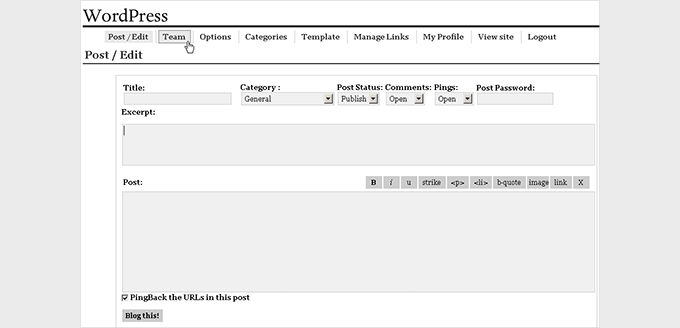
In May 2003, they released the first version, 0.7, of WordPress, a name suggested by blogger Christine Selleck. This improved version of b2 introduced features like XHTML 1.1-compliant templates, a new admin interface, themes, and the ability to make some manual changes.
2004: Introduced with ‘Mingus’

In January 2004, WordPress released its next version, 1.0, named “Davis” after the renowned American trumpeter Miles Davis.
In May 2004, version 1.2, named “Mingus,” was released after the famous American Jazz musician Charles Mingus. This version introduced support for plugins, which are additional programs developed independently that enhance the functionality of WordPress websites.
Eventually, it opened up the possibility for developers and users to customize their WordPress sites according to their needs. It was one of the impactful updates in the journey of WordPress.
2005: Major Update

In February 2005, version 1.5 (Strayhorn) was released by WordPress. This update came with a new addition called themes, which were pre-built layouts for WordPress sites. Also, this update broke the header, footer, and sidebar into individual files so that if users make changes in one place, it will automatically update everywhere on your site.
In December 2005, version 2.0 (Duke) was released with a new admin dashboard. This update brought significant improvements to the user interface of the website, like the backend of WordPress became faster and more efficient, improved the editing experience, publishing new posts or articles became quicker, and many features, making it easy for users to create and manage their website.
In August 2005, one of the co-founders of WordPress, Matt Mullenweg, founded a new company named “Automattic Inc.” and on 1 March 2006, Automattic Inc. officially registered the trademark of WordPress and its corporate logo.
2007: Introduce Auto Update

In January 2007, WordPress released its new version, 2.1, which includes an auto-saving feature. Now you won’t lose your editing anymore.
2008: Various Updates
In 2008, WordPress added new features throughout the year, like shortcodes, plugin installation, and easy updates, through various releases.
2010: Another Major Update
In June 2010, WordPress released a new version, 3.0 (Thelonious), which turned out for a significant milestone in the journey of WordPress.
This new release includes many new features, like custom post types, improved custom taxonomies, headers, menus, customizable backgrounds, and more. It was also introduced with a new default theme, Twenty Ten.
Moreover, the WordPress MU project merged with the WordPress core to form the Multisite networks. So from then on, it was easy for users to create multiple sites on a single WordPress installation.
2011: Post Format and Admin Bar
Version 3.1 was released this year, which gives multiple features, including a redesigned workspace with improved functionality, like post format support, network admin, import and export enhancements, and other improvements that offer more flexibility and customization options.
Also, in that time, some new plugins were developed that allowed you to design an e-commerce website.
2012 to 2017: Bug Fixes, Security, and Maintenance
In between these years, WordPress worked immensely to improve its core functionality and ensure a better user experience.
WordPress, released in 2012, introduced a theme customizer, previewer, and media manager. So users can easily edit the colors, background, and images as they want, make their gallery, and see the preview of these changes.
In 2013 and 2014, WordPress changed its dashboard appearance and made it easier to use for any device. It also improves support for more languages, visual post editor, live widget preview, and other options.
Another big event happened in the journey of WordPress in 2015 when Automattic Inc. acquired WooCommerce, the best WordPress plugin for creating eCommerce websites.
Various versions released in 2016 and 2017 focused on refinement and ease of use. The updation of plugins and themes, different languages in the admin panel, and added custom CSS features with a live preview make customization easy.
The release of version 4.9 in 2017 added features like widgets that allow you to add video, audio, image, text, and more, which improved the overall customization ability of the website.
2018: Introduced With Gutenberg
In 2018, the journey of WordPress turned into a new era when they released version 5.0, which introduced a new WordPress block editor called Gutenberg.
The main motto of this release was to replace the famous Classic editor with a new block-based editor to improve the site editing experience, speed, and performance. To know more about Gutenberg, read our article on how to set up a website using the WordPress block editor.
2019 to 2021: Site Health, Lazy Loading Image, and Drag-and-Drop Inserter
In between these years, various version was launched from 5.1 to 5.8. In 2019, versions 5.1 and 5.2 focused on improving site health. It allows users to fix their fatal errors through recovery mode.
Even in the year (2020) of the pandemic, the journey of WordPress didn’t stop its growth and released three versions, 5.4, 5.5, and 5.6. In addition to several changes, some essential improvements were made, such as improving the block editor’s functionality and making customization easier. It also includes new features like block patterns, block directories, and privacy settings, and introduces the lazy loading of images for better site performance.
In 2021, versions 5.7 and 5.8 were released which focused on the block editor. The update provides more control over the block pattern and style, a one-click switch between HTTP to HTTPS, and makes it easy to drag and drop the blocks to create a website.
2022: Full Site Editing

In 2022, version 5.9 was released, focused on continuing to improve the functionality of the Gutenberg Block Editor. More block patterns and features were added that enhance the full-site editing experience.
On 24 May 2022, version 6.0 was launched to bring more full-site editing features, including multiple style variations, new templates, more design tools, block locking control, and improved performance.
WordPress 6.1 (Misha) version was released on 1 November 2022, which includes a new default full-site editing theme, Twenty Twenty-Three, that supports fluid typography, lock setting for all blocks, navigation editing option, content-only editing, and more.
2023: Reimagined Site Editor
Version 6.2 (Dolphy) was released on 29 March 2023, which was another major update in the journey of WordPress, which enhances the site editor, offers better menu management, new header and footer patterns, improves the writing experience, and more. It also improves performance and functionality.
The new version, 6.3 (Lionel), was launched on 8 August 2023, which introduced a redesigned site editor allowing users to manage their entire site from content and templates to patterns- all in one place. The addition of features like the block navigation menu and improved block theme simplifies the process of building a website. Additionally, new blocks such as Footnotes and Details were added to enhance content creation. This release also prioritizes improvements, resulting in faster load speeds.
Version 6.4 (Shirley), which comes out on 7 November 2023, focuses on performance and design enhancement. It introduced a new default theme, Twenty Twenty-Four, designed to cater to any website’s needs with clean and easy customization. Block editing is enhanced with a faster command palette and the ability to set background images for groups of blocks. Pattern tools are also improved for easier import and export. Moreover, it also introduced block hooks for developers to create custom functionality.

2024: Enhanced Core Functionalities and Redesign

WordPress 6.5 (Regina), launched on 2 April 2024, is a significant update for both content creators and developers like Web Wizards USA. A notable addition is a new font library, simplifying the use and management of fonts across the website. Improved Data Views for better content organization and smoother drag-and-drop for seamless dragging throughout your workplace. Additionally, the addition of Block Bindings and Interactivity APIs allows developers to create dynamic and user-friendly websites.
WordPress 6.6 (Dorsey), launched on 16 July 2024, with improvements to the block editor. Key updates include a new side-by-side layout for better navigation, streamlined pattern management, and a revamped publishing interface showcasing titles, status, and featured image. Developers benefit from shared editing workflows and enhanced extensibility across the post/page editor and Site Editor. Performance enhancements feature an approximately 35% reduction in editor loading time and lazy loading of post embeds, resulting in a smoother, more efficient user experience.
WordPress 6.7 (Rollins) was released on November 12, 2024, marking another major upgrade with significant enhancements for users and developers. A highlight of this version is the Twenty Twenty-Five theme, which offers extensive customization and full-block editor compatibility. Users now have more control over design elements like borders, shadows, backgrounds, and spacing, making block customization more versatile. The new Zoom Out View simplifies managing content structure, while the streamlined Query Loop Block improves dynamic content display. Upgraded font management tools enable seamless customization and site-wide font control. Developers benefit from features like the Template Registration API and Block Editor API improvements, making this release more flexible, efficient, and user-friendly for all audiences.
2025: Enhanced Performance, Security, Editor, and User Experience
WordPress 6.8 (Cecil) was released on April 15, 2025, as the platform’s only major update for the year. This release introduces several key enhancements, including a redesigned Style Book with clearer labels and expanded support for Classic themes using editor-styles or theme.json. The Block Editor sees improvements like refined Data Views and the ability to exclude sticky posts in Query Loops. A notable performance upgrade is speculative loading, which preloads pages on hover or click for faster navigation. On the security front, WordPress now uses bcrypt for stronger password hashing, which is applied automatically. Accessibility also sees significant attention, with over 100 improvements across the editor, themes, customizer, and menus. WordPress 6.8 also marks the beginning of a new release cycle, moving to a single major update annually.
WordPress 6.9 (Gene), released on December 2, 2025, brings major upgrades to improve collaboration, performance, and site-building flexibility. With the new Notes feature, users can leave block-level comments directly inside posts or pages, simplifying reviews and teamwork. The enhanced Command Palette is now accessible from anywhere in the dashboard, enabling quicker navigation and streamlined workflows for creators and admins. Under the hood, the new Abilities API provides a standardized, machine-readable permissions system, a foundation for future AI-powered workflows and automation. Developers and site owners also benefit from improved performance: faster page loads, optimized queries and caching, and more responsive front-end behavior. New content-creation blocks, better typography options, and more intuitive drag-and-drop layout controls make building rich, dynamic pages easier than ever.
2026: AI-Integrated WordPress and a Modernized Dashboard
In May 2026, WordPress launched Version 7.0 “Armstrong,” a landmark release that introduced the foundation for AI-powered workflows and a refreshed user experience.
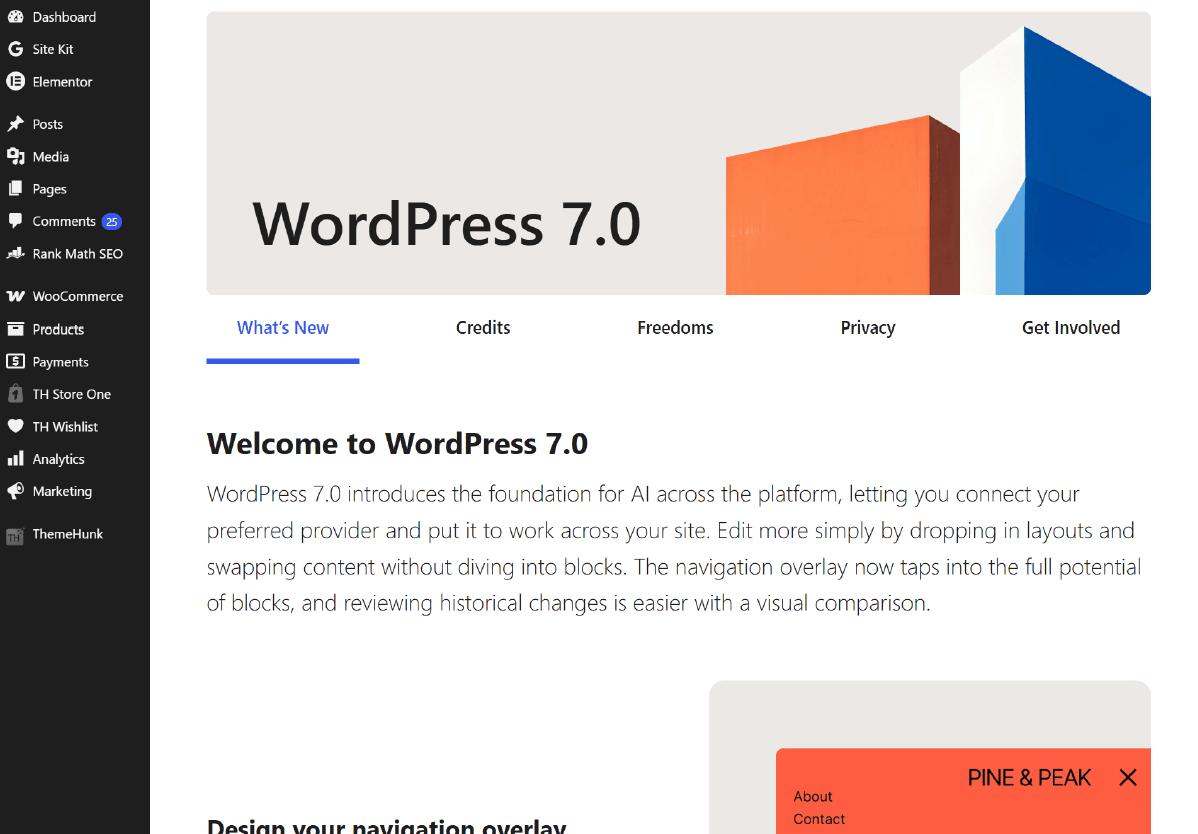
Key Highlights:
- AI-Integrated WordPress: WordPress 7.0 introduced a new AI framework with the AI Client and Abilities API, enabling AI-assisted content creation, image generation, automation, and seamless integration with leading AI models such as ChatGPT, Claude, and Gemini.
- Modernized Dashboard: The admin interface received a major redesign featuring a cleaner look, improved navigation, smoother interactions, and a new Command Palette (⌘K/Ctrl+K) for faster access to tools and settings.
- Enhanced Design Tools: New blocks such as Breadcrumbs and Icons, improved Gallery and Heading blocks, built-in lightbox support, and responsive visibility controls made site design more flexible than ever.
- Developer Improvements: Developers gained the ability to create blocks and patterns using PHP, along with expanded Site Editor capabilities and more extensible APIs.
WordPress 7.0 marked the beginning of the platform’s AI era while delivering significant improvements for users, designers, and developers alike.
If you wish to learn more about the journey of WordPress, you can visit their history page here.
Conclusion
From the simple blogging tool to the world’s most used content management system, WordPress has grown significantly since its first release on May 27, 2003.
The journey of WordPress over the years has gone through significant changes and added many new features through various updates. With each new version, they introduced new features and bug fixes to enhance the performance and make it more accessible for users.
What next? WordPress will continue its growth and commitment to improving its core functionality and providing a more user-friendly and feature-rich platform for every user.
FAQ
Q: When was the first version of WordPress released?
Ans: The first version of WordPress, version 0.7, was released on 27 May 2003.
Q: Who founded WordPress?
Ans: In 2003, American blogger Matt Mullenweg and British blogger Mike Little started WordPress as a fork of b2.
Q: What is the latest major version of WordPress?
Ans: The latest version of WordPress is 7.0 (Armstrong), released on 20 May 2026.
Q: Major updates to WordPress?
Ans: The first major update was released in 2004 as version 1.2, and in the years that followed, more major updates were released as versions 1.5, 2.0, 3.0, 5.0, 5.9, 6.2, 6.7, 6.8, and 7.0.
We hope this article helped you to know the 20-year’ journey of WordPress.
If you find this article helpful, do share it with your friends. And If you have any questions regarding this, do not hesitate to comment below. We will help you solve your problem. Thanks for reading this blog.
Please subscribe to our YouTube Channel, we also upload great content there, and follow us on Facebook and Twitter.
More Helpful Read –
- Best Free WordPress Block Themes [Full Site Editing]
- Best Free WordPress Agency Themes [Top Picks]
- Best Free WooCommerce WordPress Themes for eCommerce Websites
- Best Free WordPress Plugins For Your Website
Recommended WordPress Themes
| Theme | Purpose | Get Deal |
|---|---|---|
| Zita | Multipurpose | Get Discount |
| Shop Mania | WooCommerce | Get Discount |
| Divi | Multipurpose | Get Discount |
| GeneratePress | Multipurpose | Get Discount |


