
WooCommerce Vs Shopify Vs Opencart, unsure which eCommerce platform you choose for your business. Don’t worry, we are here to help you make the right choice.
OpenCart, Shopify, and WooCommerce are three popular eCommerce solutions that offer unique features and strengths to meet diverse business needs.
As more businesses move online, it’s important to understand these platforms’ strengths and weaknesses to make the right choice for success.
This detailed comparison explores the key ease of use, strengths, scalability, and customization features of OpenCart, Shopify, and WooCommerce.
Whether you’re starting a new business or running an established one, it’s here to help you make a smart choice.
Choosing an eCommerce platform isn’t just about technology, it’s a decision that can shape the future of your business.
WooCommerce Vs Shopify Vs OpenCart
| Feature | WooCommerce | Shopify | OpenCart |
|---|---|---|---|
| Type | WordPress Plugin (Open-source) | Hosted SaaS platform | Open-source |
| Pricing | Free (Hosting-Cost) | Subscription-based | Free (Hosting-Cost) |
| Ease of Use | Moderate | Easy | Moderate |
| Hosting | Self-hosted (via WordPress) | Self-hosted | Self-hosted |
| Customization | Very High | Limited | High |
| Themes & Plugins | Extensive | Large official store | Moderate selection |
| SEO | Excellent | Good | Good |
| Scalablity | High | High | Moderate |
| Support | Unlimited official and strong community support | 24/7 Dedicated support | Limited official and community support |
| Payment Gateways | Support multiple gateways | Shopify Payments and others | Support multiple gateways |
| Security | User-managed (WordPress security, plugins, and hosting dependent) | Shopify-managed (Advanced built-in security) | User-managed (Basic and third-party extensions needed) |
| Best For | Any store size | Small to Enterprize stores | Scalability |
Now, let’s take a closer look at each platform individually.
WooCommerce
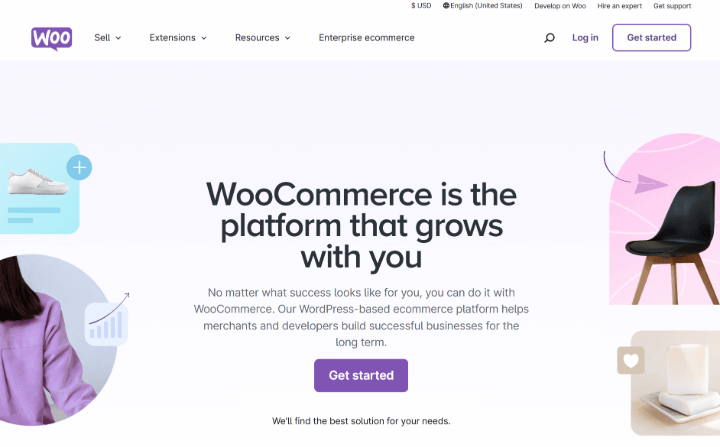
WooCommerce is a powerful open-source e-commerce plugin specifically designed for WordPress that offers businesses a versatile solution to create and manage robust online stores.
It offers an extensive set of features that empower store owners to efficiently manage every aspect of their online business, including product management, order processing, payment gateways, and shipping options.
Thanks to its flexibility, WooCommerce can be adapted for businesses of any size, allowing them to personalize the platform to meet their unique needs and objectives.
WooCommerce was introduced by WooThemes in 2011 and quickly became popular for its seamless integration with WordPress, the leading CMS.
After being acquired by Automattic in 2015, WooCommerce has become one of the most popular e-commerce platforms globally.
Its open-source nature allows businesses to customize and expand functionality using a vast ecosystem of plugins, themes, and developers.
Whether a business needs a simple storefront or a more complex online multivendor marketplace, WooCommerce provides the tools and scalability to grow the business.
Key Features
- Seamless WordPress Integration: WooCommerce is deeply integrated with WordPress, which powers over 43% of websites globally.
- Customization: With thousands of themes and plugins, store owners can customize their storefronts without extensive coding knowledge.
- Product Management: Supports various product types, including physical, digital, subscriptions, and variable products.
- Secure Payments: Integration with popular payment gateways like PayPal, Stripe, and Square ensures secure transactions.
- Shipping Options: Offers customizable shipping methods, including flat rates, free shipping, and real-time carrier rates.
- SEO-Friendly: As a WordPress-based platform, WooCommerce benefits from its strong SEO features.
- Responsive Design: WooCommerce offers a fully responsive design, optimizing your online store for seamless performance and an appealing look across all devices, enhancing user experience.
Extensions and Plugins
The WooCommerce ecosystem includes over 900 extensions, ranging from advanced analytics, marketing tools, and inventory management to customer loyalty programs. These enable businesses to enhance store functionality and optimize their online operations effectively.
Community and Support
WooCommerce has a vast global community of developers, store owners, and contributors. Users can access extensive documentation, forums, and professional support to help with troubleshooting and store optimization.
Pros and Cons of WooCommerce
Pro’s ✅
- Free and Open source
- Build with WordPress
- Highly customizable
- Easy to setup
- Large extension library
- Marketing Tools and SEO
- Payment gateway integration
- Large community support
- Scalable
Con’s 🚫
- Require technical knowledge
- Become costly with premium plugins and extensions
- Hosting cost
- Beginners may find difficulty in understanding
Pricing
WooCommerce is free to install and use, but costs may arise from web hosting, premium themes, and plugins which depend on customization, advanced features, and specific business requirements.
Some of the best hosting for WooCommerce are WordPress.com, Pressable, Kinsta, and Hostinger.
Ideal For
- Small to large businesses
- Entrepreneurs and online store owners
- Businesses needing highly customizable store
- WordPress-based businesses looking for eCommerce integration
Shopify

Shopify is a leading cloud-based eCommerce platform designed to help businesses create, manage, and grow their online stores with ease.
Shopify was founded in 2006 by Tobias Lutke, Daniel Weinand, and Scott Lake to make online selling easier after they struggled to build a website for their snowboard store. Since then, Shopify has become one of the world’s most popular e-commerce solutions.
Shopify’s key strengths lie in its user-friendly interface and intuitive dashboard, making it accessible to both beginners and experienced entrepreneurs to manage inventory, track sales, and process payments seamlessly.
Shopify also provides a range of customizable themes and apps that enable store owners to design personalized shopping experiences that align with their brand’s unique identity.
Shopify prioritizes security with built-in SSL certificates and PCI-DSS compliance for secure transactions. Its scalability makes it ideal for startups, growing businesses, and large enterprises.
Key Features
- User-Friendly Interface: Shopify offers an intuitive drag-and-drop store builder, allowing users with no coding experience to create professional online stores.
- Customizable Themes: It offers 100+ free and premium themes that help you design visually appealing storefronts.
- Payment Gateways: It supports 100+ payment providers, including Shopify Payments, PayPal, Stripe, and more, ensuring seamless transactions.
- Inventory Management: Offer real-time inventory tracking, low-stock alerts, and SKU management to simplify product handling.
- Mobile-Friendly: Its fully responsive design ensures your store looks great on mobile devices.
- SEO and Marketing Tools: It provides built-in SEO tools, blogging features, discount codes, and marketing automation to help drive traffic and sales.
- Omnichannel Selling: Sell across social media platforms (Facebook, Instagram, Pinterest), marketplaces (Amazon, eBay), and offline using Shopify POS (Point of Sale).
- Analytics and Reporting: Advanced analytics dashboards provide insights into customer behavior, sales trends, and performance metrics.
Pros and Cons of Shopify
Pro’s ✅
- Easy to set up and use
- Multiple customizable themes and apps
- Multiple Dropshipping
- Payment and shipping options
- Social commerce integration
- Inventory management.
- 24/7 customer support
- Scalable
Con’s 🚫
- Transaction fees on external payment gateways
- Costs rise with premium apps and add-ons
- Low blogging features
- Limited customization
- Yearly/monthly subscription fees
Pricing
Shopify offers various pricing tiers to cater to different business sizes:
| Basic | Shopify | Advanced | Plus |
|---|---|---|---|
| $29/month | $79/month | $299/month | $2,300/month |
Additional costs may include transaction fees, premium themes, and third-party apps, depending on your store’s needs and features.
Shopify also offers enterprise-level plans with custom pricing to support large-scale businesses with advanced needs.
Ideal For
- Entrepreneurs and small businesses
- Dropshipping businesses
- Enterprises with high scalability needs
- Multi-channel retailers
OpenCart

OpenCart is a free, open-source eCommerce platform designed to help businesses easily build, manage, and grow their online stores.
Since Daniel Kerr launched it in 2010, OpenCart has become widely recognized for its easy-to-use interface and efficient, lightweight structure, making it one of the top choices for small- to medium-sized businesses.
Its intuitive admin dashboard simplifies essential tasks such as inventory management, order processing, and customer tracking, allowing business owners to focus on growth rather than technical complexities.
OpenCart provides extensive customization options and supports thousands of themes and extensions, enabling businesses to personalize their online stores.
Additionally, OpenCart supports multiple payment gateways and shipping integrations, ensuring flexibility in managing transactions and logistics.
OpenCart allows businesses to manage multiple stores from a single admin panel. Its active global community of developers and contributors constantly enhances the platform, providing frequent updates, tutorials, and reliable support.
Key Features
- Open-Source: OpenCart is available for free download, installation, and use, making it a cost-effective option for startups and small businesses.
- User-Friendly Dashboard: The intuitive admin interface provides valuable insights into sales, customer data, and overall store performance, helping businesses manage and optimize operations efficiently.
- Product Management: OpenCart supports an unlimited number of products, categories, and manufacturers, along with options for product variants, digital downloads, and other customizable features, providing flexibility to scale and manage your online store.
- Multi-Store Functionality: Control and manage multiple online stores from one unified dashboard, offering centralized management of all your business operations.
- Payment and Shipping Integrations: OpenCart supports multiple payment gateways and various shipping options, including flat-rate and weight-based shipping, offering businesses flexibility.
- Extension Marketplace: With over 13,000 extensions, OpenCart offers themes, modules, payment gateways, and marketing tools, enabling businesses to enhance store functionality.
- Multi-Language and Multi-Currency Support: OpenCart’s support for multiple languages and currencies enables businesses to scale globally, providing a seamless shopping experience for customers across different regions and international markets.
- SEO-Friendly: OpenCart has built-in SEO features, such as customizable meta tags and URLs, enabling businesses to boost search engine rankings.
- Responsive Design: The themes are mobile-friendly, providing a smooth and consistent shopping experience across all screen sizes and devices.
Community and Support
OpenCart has an active global community that provides forums, detailed documentation, and third-party developer support. Additionally, official paid support is available for businesses requiring dedicated assistance.
Pros
Pro’s ✅
- Free and open-source
- Lightweight and easy to set up
- High customization
- Multi-store and multi-language support
- Vast extension marketplace
- Multi-store functionality
- Flexible payment gateways
- Global community support
Con’s 🚫
- Requires technical expertise
- Limited built-in features
- Support limitation
- Less user-friendly for beginners
- Requires external Hosting
Pricing
OpenCart is free to download and use, but additional costs may include paid themes, extensions, hosting, and support services, depending on your store’s specific requirements and features.
Ideal For
- Small to medium-sized businesses
- Entrepreneurs seeking cost-effective e-commerce solutions
- Businesses that prefer high customization
Factors to Consider When Selecting a Platform
Here are some important factors you should consider when choosing a platform among WooCommerce Vs Shopify Vs OpenCart:
- Budget: Consider your budget for initial setup, ongoing expenses (hosting, subscriptions, transaction fees), and potential development costs for development and customization.
- Technical Expertise: Evaluate your technical skills or the availability of in-house resources. If you lack the required technical expertise, Shopify, with an easier setup, might be a more suitable choice.
- Scalability: Think about your long-term growth goals. Select a platform that can easily expand to handle more traffic, orders, and product inventory as your business grows.
- Customization: Determine the level of customization you require. If you need high customization, OpenCart or WooCommerce could be more suitable options for your business.
- Ease of Use: If a fast and simple setup is a priority, focus on ease of use. Shopify stands out for its user-friendly setup process.
- Features: Evaluate the platform’s built-in features and the availability of third-party apps, extensions, and themes to ensure it offers the tools and integrations needed to meet your unique business needs and objectives effectively.
FAQ
Q: WooCommerce Vs Shopify Vs OpenCart: Which platform is best for beginners?
Ans: Shopify is the easiest platform for beginners, offering an all-in-one hosting solution, a user-friendly interface, and a drag-and-drop builder. On the other hand, WooCommerce and OpenCart are self-hosted, requiring external hosting, and more technical expertise for setup and maintenance.
Q: Which platform is more customizable?
Ans: WooCommerce is the most flexible platform, offering complete control over design and functionality through plugins and custom code. OpenCart also supports significant customization with its variety of extensions. While Shopify offers customization within its structured ecosystem and app integrations.
Q: Which platform is more affordable WooCommerce Vs Shopify Vs OpenCart?
Ans: WooCommerce and OpenCart are generally more affordable as they are open-source and free to install. However, hosting, themes, plugins, and extensions add costs. While Shopify offers a fixed monthly subscription model but can be costly with premium apps and transaction fees.
Q: Which platform is better for scalability?
Ans: Shopify and WooCommerce are both highly scalable. Shopify handles scalability through its built-in infrastructure while WooCommerce depends on the hosting environment. OpenCart also offers scalability but may need more customization and hosting resources.
Q: WooCommerce Vs Shopify Vs OpenCart: What are the hosting requirements?
Ans: Shopify is a fully hosted platform, no need for third-party hosting. On the other hand, WooCommerce and OpenCart are self-hosted platforms, WooCommerce needs external hosting with WordPress, while OpenCart also requires third-party hosting.
Final Words
Choosing between WooCommerce Vs Shopify Vs OpenCart is crucial for the success of your online business.
While OpenCart, Shopify, and WooCommerce each have their strengths and weaknesses, the best choice depends on your specific needs, budget, and technical expertise.
Here’s a summary that may help you decide:
- Choose WooCommerce: If you need a user-friendly, highly customizable platform integrated with WordPress. It offers extensive themes, plugins, scalability, and full control, making it perfect for businesses looking to grow and fully personalize their online store.
- Choose Shopify: If you want an easy-to-use e-commerce platform with a quick setup. Its user-friendly interface, built-in features, and scalability make it ideal for businesses seeking efficiency and growth.
- Choose OpenCart: If you need extensive customization options, an easy-to-use interface, and scalability for small to medium-sized businesses looking for flexibility without high costs.
Thanks for reading this blog. If you find this article helpful, do share it with your friends. If you have any questions regarding this, do not hesitate to comment below. We will help you to solve your problem.
We hope this article will help you find the best eCommerce platform for your business among WooCommerce Vs Shopify Vs OpenCart.
Please Subscribe to our YouTube Channel, we also upload great content there, and also Do Follow us on Facebook and Twitter.
More Helpful Reads:


