
Quick Key Points:
- WordPress Market Share: Powers 43.4% of all websites globally, leading all CMS.
- Popularity: Evolved over 20 years to support blogs, e-commerce, and corporate sites.
- Usage: Over 63.4 million websites use WordPress worldwide.
- Global Reach: Widely used across countries like the US, Germany, and the UK.
- Trends: Adapting with full-site editing, AI integration, and enhanced security.
When you’re planning to create a website, you’ll hear a lot about different content management systems (CMS), especially WordPress.
You might wonder just how popular WordPress is and how it compares to other CMS options. Let’s explore WordPress’s market share and see how it measures up against its competitors.
WordPress is known for its ease of use, flexibility, and an extensive library of free themes and plugins that can enhance your website’s functionality and appearance.

It powers millions of websites, from personal blogs to large corporate sites, making it a go-to choice for many web developers and online business owners to create a website.
This article delves into the Insights and Analysis surrounding WordPress, providing insights into its dominance, growth, and prospects.
Let’s dive deeper into how WordPress compares to its competitors in terms of market share, features, and overall usability.
WordPress has grown from a simple blogging tool to the most popular CMS in the world. But what exactly has driven this platform to such heights?
Let’s dive into the statistics and trends that highlight the dominance of WordPress in the market.
WordPress Market Share: It Powers 43.4% of All Websites
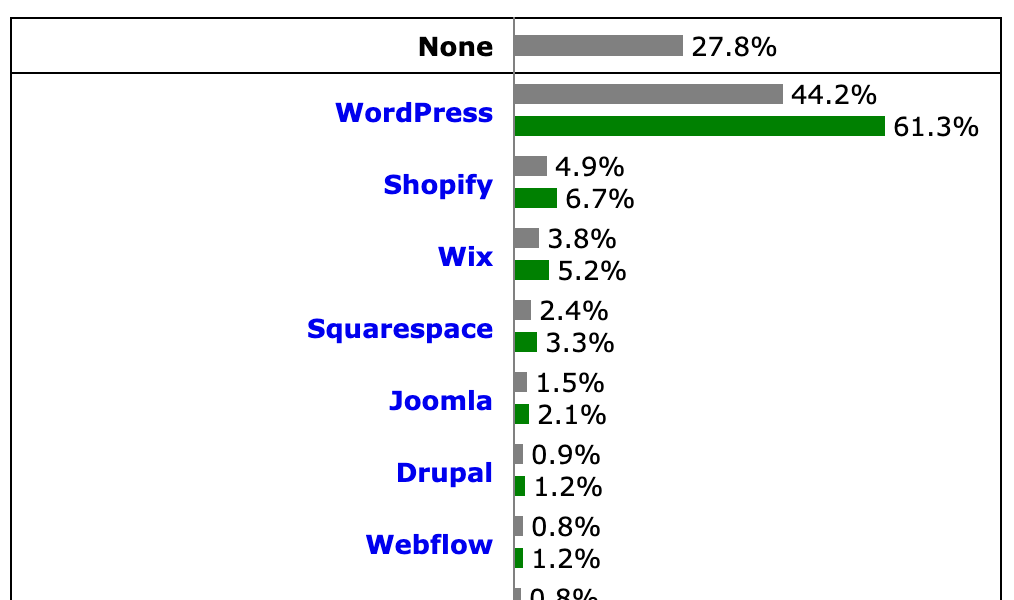
As of 2026, WordPress’s Market Share Powers 43.4% of all websites on the Internet, and it is the most popular content management system (CMS) in the world, according to W3Techs statistics.
| Rank | CMS | Market Share | CMS Share |
|---|---|---|---|
| 1 | WordPress | 43.4% | 60.8% |
| 2 | Shopify | 4.6% | 6.6% |
| 3 | Wix | 3.2% | 4.5% |
| 4 | Squarespace | 2.2% | 3.1% |
| 5 | Joomla | 1.6% | 2.3% |
It holds a 60.8% market share for all content management systems (CMS).
The Journey of WordPress is amazing. It was first released to the public on 27 May 2003 by Matt Mullenweg and Mike Little.
Its first version was released on May 27, 2003. What started as a basic platform for personal blogs soon evolved into a robust CMS.
Over the last 20 years, WordPress has introduced multiple features, bug fixes, and improvements through various versions.
Number of Websites Powered by WordPress
According to Built With Data, a staggering 63.4 million websites on the internet are powered by WordPress.
This impressive figure highlights the widespread popularity and trust that WordPress has garnered among website owners, developers, and businesses alike.
As an adaptable and user-friendly content management system (CMS), WordPress offers a robust platform for creating a wide variety of websites, ranging from personal blogs to complex e-commerce sites and large corporate portals.
Its vast library of themes and plug-ins allows users to customize their websites to meet specific needs and preferences, further contributing to its dominance in the web development landscape.
Is WordPress in Demand in 2026?
Yes, WordPress remains in demand in 2026, continuing its strong presence as one of the most popular content management systems (CMS) globally.
WordPress remains not only relevant but also essential in 2026 for businesses, developers, and content creators seeking a versatile, scalable, and user-friendly platform for their online presence and growth strategies.
Here are Google Trends Stats:
Its continuous evolution and widespread adoption ensure its place at the forefront of web development technologies.
WordPress is known for its ease of use, allowing even non-technical users to manage and update websites with minimal training.
There is a vast ecosystem of developers, designers, and agencies that specialize in WordPress, providing a rich resource for support, themes, plugins, and customization options.
As an open-source platform, WordPress itself is free to use. While you may incur costs for themes, plugins, and hosting, overall, it is a cost-effective solution compared to proprietary CMS options.
WordPress and E-commerce
WordPress is a universal platform that supports e-commerce through various plugins, notably, WooCommerce.
WooCommerce is the most popular e-commerce plugin for WordPress. It integrates seamlessly with WordPress, allowing you to set up an online store quickly.
WooCommerce Integration
WooCommerce offers features like product management, order processing, payment gateway integration, and more.
Installing WooCommerce is straightforward through the WordPress dashboard. Once installed, you can configure settings such as currency, shipping options, taxes, etc., to suit your business needs.
WordPress and WooCommerce are highly customizable. You can choose from numerous themes designed specifically for e-commerce or customize them according to your brand.
Whether you’re starting a small online store or planning to scale up, WordPress and WooCommerce can accommodate your needs.
WordPress Market Share in Online Stores
WooCommerce holds a significant market share among online store Content Management Systems (CMS). Currently, however, most of the eCommerce market share is held by Shopify.
Over 6.2 million websites use WooCommerce. This number speaks volumes about its popularity and adoption rate.
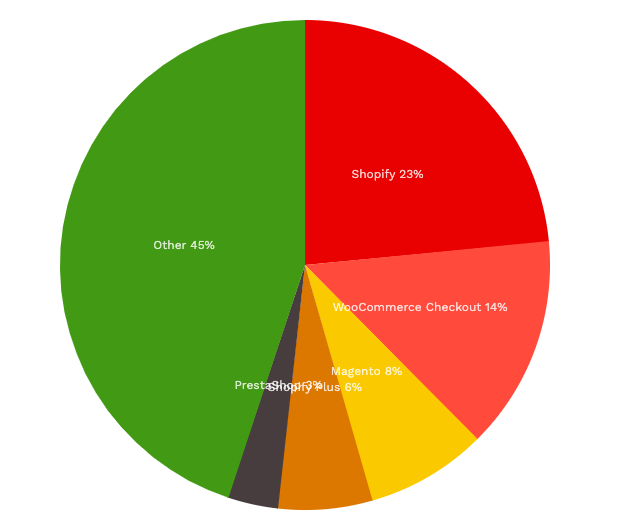
According to Build With, eCommerce Usage Distribution in the Top 1 Million Sites are held by Shopify 23%, WooCommerce 14%, Magento 8%, and the rest of the others.
The WooCommerce numbers are increasing as users find it more open source than any other eCommerce CMS.
WooCommerce stands out for its integration with WordPress and flexibility, while platforms like Shopify, Magento, and BigCommerce offer varying degrees of ease of use, scalability, and customization options suited to different business needs and preferences.
Read More- Shopify vs WooCommerce vs BigCommerce vs Wix vs Magento vs Jimdo
Country-Wise Number of Websites Using WordPress
WordPress is a globally recognized and widely used content management system, powering millions of websites across various countries.
According to Built With Data, here’s a breakdown of the number of websites using WordPress by country:
| Country | Number of Websites |
|---|---|
| United States | 3.6 Million |
| Germany | 1.7 Million |
| United Kingdom | 1.3 Million |
| Brazil | 964.2K |
| France | 933.9K |
| Netherlands | 871.2K |
| Italy | 856K |
| Russia | 730K |
| Japan | 697K |
| India | 636K |
Popular Websites Using WordPress
WordPress is one of the most widely used content management systems (CMS) globally, powering a significant portion of websites on the internet. Here are some popular websites that use WordPress:
- NASA– the United States’ space agency
- The White House– Official residence and workplace of the President of the United States
- PM India- Official Website of the Prime Minister of India
- TechCrunch– A leading technology news website.
- Sony Music- A global recorded music company.
- Microsoft News– A news aggregator and service operated by Microsoft.
- Facebook– Facebook’s official newsroom website.
- Angry Birds– Mobile gaming sensation Angry Birds website
Read More- 21+ Most Popular Websites Built with WordPress
Reasons for WordPress’s Popularity Among Top CMS
WordPress enjoys immense popularity among Content Management Systems (CMS) for several reasons. Here are the most important reasons:
User-Friendly Interface and Ease of Use-
WordPress is renowned for its user-friendly interface, making it accessible even to non-technical users. Managing content, adding pages, and updating posts are straightforward tasks.
It supports a wide range of website types, from blogs to e-commerce stores and corporate websites.
Extensive Customization Options
WordPress offers extensive customization options, primarily through its themes and plugins, which empower users to tailor their websites according to specific needs and preferences.
Overall, the combination of themes, plug-ins, Website builders, and custom development capabilities makes WordPress highly customizable, catering to a wide range of website requirements from simple blogs to complex e-commerce platforms and enterprise solutions.
Strong Community Support
WordPress enjoys strong community support, which is a crucial factor contributing to its popularity and success as a Content Management System (CMS).
The strong community support around WordPress fosters a collaborative and supportive environment where users can learn, grow, and contribute.
This community-driven approach is instrumental in WordPress’s ongoing success and its ability to adapt to the evolving needs of users and the web development industry.
WordPress Usage by Industry
- Publishing, Media and Blogs: WordPress is popular among publishers, bloggers, and media outlets due to its robust blogging capabilities and content management features.
- Education: Educational institutions such as schools, universities, and online learning platforms use WordPress to create and manage their websites.
- E-commerce: While WordPress itself provides basic e-commerce functionality through plugins like WooCommerce, it’s widely used in conjunction with other e-commerce platforms or plugins to create online stores.
- Government: Some government agencies and municipalities use WordPress to create websites for civic engagement, public information, and community outreach.
- Nonprofits: Nonprofit organizations often use WordPress to create websites that support their missions.
- Real Estate: Real estate agencies and agents use WordPress to showcase property listings, manage inquiries, and provide information to potential buyers and renters.
WordPress is widely used because it’s flexible and has lots of plugins. It helps businesses and organizations make and manage websites easily.
Trends in WordPress Development
Here are some of the latest trends in WordPress development:
1. Full-Site Editing (FSE)
Full-site editing (FSE) is another trend that allows users to edit their entire website, including headers and footers, directly from the WordPress dashboard.
2. Headless WordPress
Headless WordPress is gaining traction, enabling developers to use WordPress as a back-end system while delivering content through various front-end technologies.
This approach offers more flexibility and performance benefits, especially for dynamic and complex websites.
3. Enhanced Security Measures
With increasing cyber threats, security in WordPress development is paramount. Developers are focusing on implementing robust security practices, such as two-factor authentication, regular updates, strong password policies, and the use of secure plug-ins and themes.
4. Artificial Intelligence (AI) Integration
AI Tools and machine learning are being integrated into WordPress for various applications, including content recommendations, chatbots, and enhanced analytics. These technologies can improve user experience and offer personalized content.
5. Theme and Plugin Customization
There is a growing trend towards developing highly customizable themes and plugins. Users want more control over the design and functionality of their websites without needing to write code.
Staying updated with the latest trends in WordPress development is crucial for developers to create modern, efficient, and user-friendly websites.
WordPress Security Trends and Concerns
While WordPress is generally secure, its popularity makes it a target for hackers. Common vulnerabilities include outdated plugins and themes.
Automated scripts attempt to gain access by guessing usernames and passwords. Implementing strong passwords and two-factor authentication (2FA) is essential.
To counter these threats, WordPress offers numerous security plugins like Wordfence and Sucuri, which help protect websites from malicious attacks.
FAQs
Q. What percentage of websites used WordPress in 2026?
Ans. As of 2026, WordPress powers approximately 43.4% of all websites on the internet.
Q. Is WordPress suitable for large businesses?
Ans. Yes, many large businesses and corporations use WordPress due to its scalability and robustness.
Q. Can WordPress handle high-traffic websites?
Ans. Absolutely. Many high-traffic websites, including major news sites and popular blogs, use WordPress.
Q. What are the alternatives to WordPress?
Ans. Alternatives to WordPress include Joomla, Drupal, Wix, Squarespace, and Shopify, each offering different features and advantages.
Conclusion
In conclusion, WordPress stands as the undisputed leader among content management systems (CMS), commanding a remarkable 43.4% market share of all websites worldwide.
From its origins as a blogging tool to its current status as a versatile CMS supporting millions of diverse websites, WordPress owes its dominance to its user-friendly interface, extensive customization options, and strong community support.
Whether for personal blogs, e-commerce ventures, or large corporate portals, WordPress remains a preferred choice due to its scalability, flexibility, and cost-effectiveness.
As it continues to evolve, WordPress is poised to maintain its leading position in the CMS market, empowering millions of users to create stunning, functional websites.
As trends like full-site editing and AI integration shape its future, WordPress continues to evolve, ensuring its relevance and indispensability in the ever-changing landscape of web development.
If you find this article helpful, do share it with your friends. If you have any questions regarding this, do not hesitate to comment below. We will help you to solve your problem. Thanks for reading this blog.
Please subscribe to our YouTube Channel. We also upload great content there. Do follow us on Facebook and Twitter.
Read More:


